



Resveratrol
$575.00
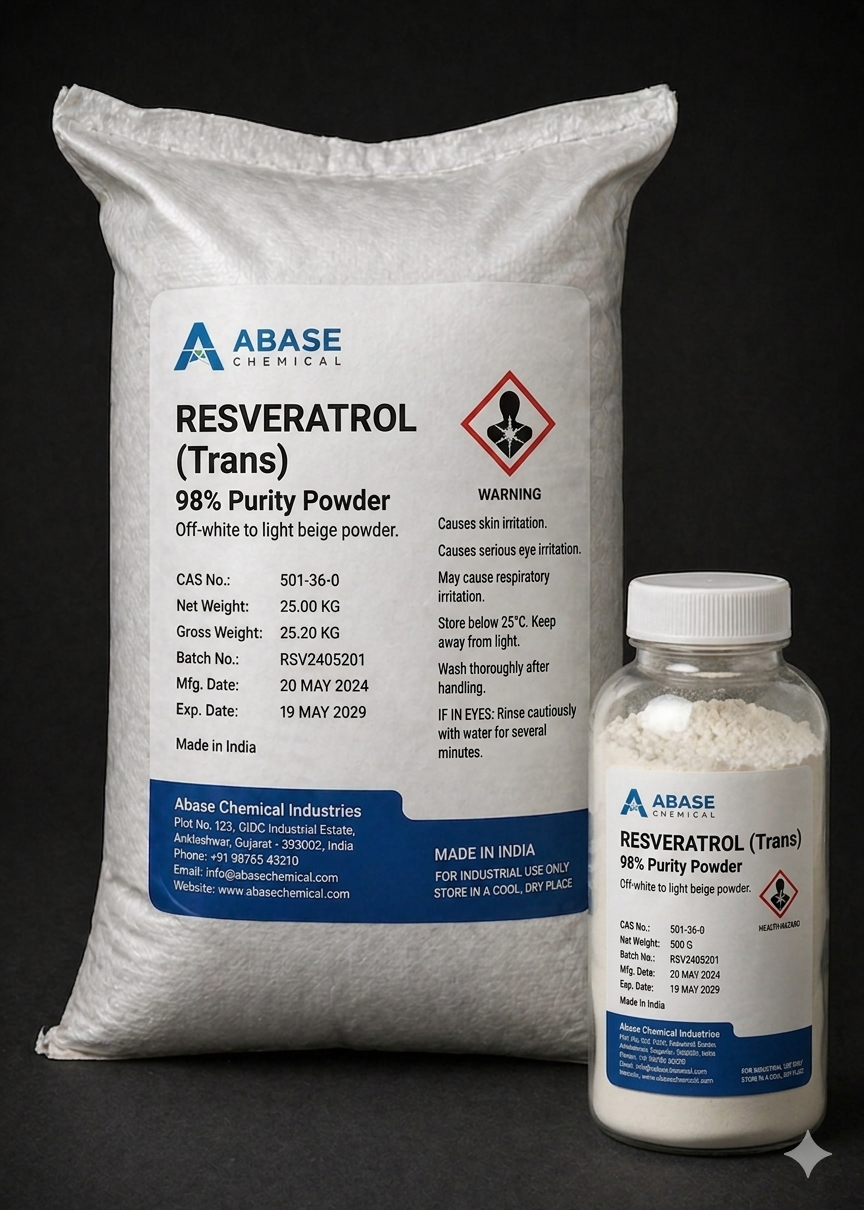
Resveratrol ($3,5,4'$-trans-trihydroxystilbene) is a naturally occurring phytoalexin and polyphenolic compound primarily recognized for its potent antioxidant and anti-inflammatory properties (Pannu & Bhatnagar, 2019; Thirumalaisamy et al., 2022). It exists in two isomeric forms: trans and cis. The trans-isomer is the most biologically active and prevalent form in nature, though it is highly sensitive to environmental factors (MDPI, 2025; Wikipedia, 2026).
Storage and Stability Conditions
Resveratrol is chemically unstable and prone to degradation if not handled correctly. Its double bond makes it particularly sensitive to light and temperature (Tian & Liu, 2020).
Light Sensitivity: Exposure to UV radiation or visible light (namely at 360 nm and 254 nm) triggers photoisomerization, converting the active trans-form into the less active cis-form (MDPI, 2025; RSC Publishing, 2023). Storage in amber glass or opaque packaging is mandatory.
Temperature & Humidity:
While trans-resveratrol powder is relatively stable under "accelerated stability" conditions ($40^\circ\text{C}$ and 75% humidity) (Wikipedia, 2026), liquid forms degrade rapidly at high temperatures (Zupančič et al., 2015).
Ideal Storage: Store in a cool, dry place ($2^\circ\text{C}$ to $8^\circ\text{C}$ for long-term stability of solutions; room temperature for sealed powders) (Zupančič et al., 2015).
pH & Oxidation:
Resveratrol is stable in acidic environments but degrades rapidly in alkaline pH (above pH 8) (RSC Publishing, 2023).
It is susceptible to auto-oxidation when exposed to oxygen; therefore, headspace in containers should be minimized or purged with an inert gas like Nitrogen ($N_2$).
Resveratrol is widely utilized across the food, pharmaceutical, and cosmetic industries due to its multi-pathway molecular mechanisms (MDPI, 2025).
Nutraceuticals & Supplements: It is a major ingredient in anti-aging and cardioprotective supplements (MDPI, 2025). Common dosage forms include capsules and tablets (typically 75–1000 mg), aimed at reducing oxidative stress and inflammation (Almeida et al., 2009).
Functional Foods: It is incorporated into food products as a natural antimicrobial and antioxidant to prevent lipid oxidation, thereby extending shelf life and preserving nutritional quality (RSC Publishing, 2023; PMC, 2024).
Pharmaceutical Research: Research focuses on its potential as a co-adjuvant in cancer therapy, diabetes management (reducing complications when combined with hypoglycemic drugs), and neuroprotective treatments for Alzheimer’s and Parkinson’s (MDPI, 2025; PMC, 2024).
Advanced Delivery Systems: Due to its low oral bioavailability (less than 1%), the industry is shifting toward encapsulation in nanoparticles and nanocarriers to improve absorption, stability, and targeted delivery (Nguyen et al., 2022; RSC Publishing,2023